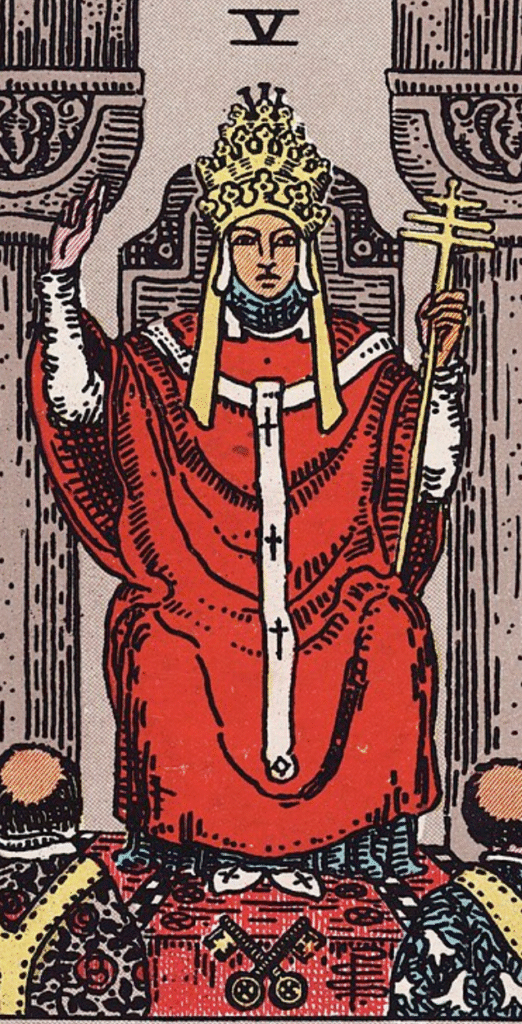
The Hierophant

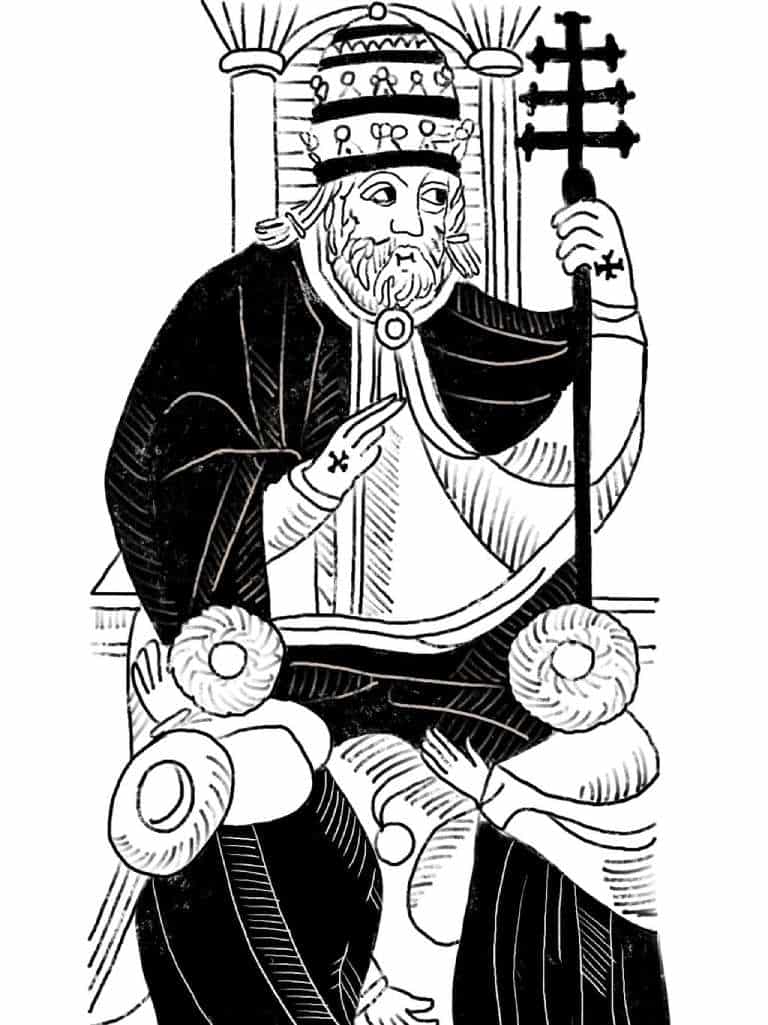
The Pope card from the Marseille tarot, black and white.

Symbols

Papal crown, Triple cross scepter, Crossed keys, Pillars, Clerical robes, Raised hand, Two acolytes at his feet

Qualities

Tradition, Spiritual authority, Wisdom, Guidance, Conformity, Knowledge, Morality, Ritual

Symbology

A symbol of profound spiritual wisdom and guidance. As the fifth card in the Major Arcana, The Hierophant stands as a bridge between the earthly realm and the divine, embodying values of tradition, morality, and spiritual connection.

The Hierophant – also known as the High Priest or Pope in some decks – is a religious figure depicted in a formal and sacred environment reminiscent of a church. He is the counterpart to The High Priestess and, as she does, he sits between two pillars within a temple. His attire comprises three distinct vestments, symbolizing his connection to three different realms.

In his left hand, The Hierophant holds a triple cross, a traditional papal symbol representing the Father, the Son, and the Holy Ghost. His raised right hand offers a blessing, echoing the gesture of The Magician. At his feet, two acolytes kneel, representing his role in imparting spiritual wisdom and initiating them into the church.

The keys at The Hierophant’s feet symbolize the delicate balance between conscious and subconscious minds, underscoring his unique role as the custodian of spiritual truths.The Hierophant is a repository of spiritual wisdom and sacred teachings, and he possesses the keys to unlock these secrets.
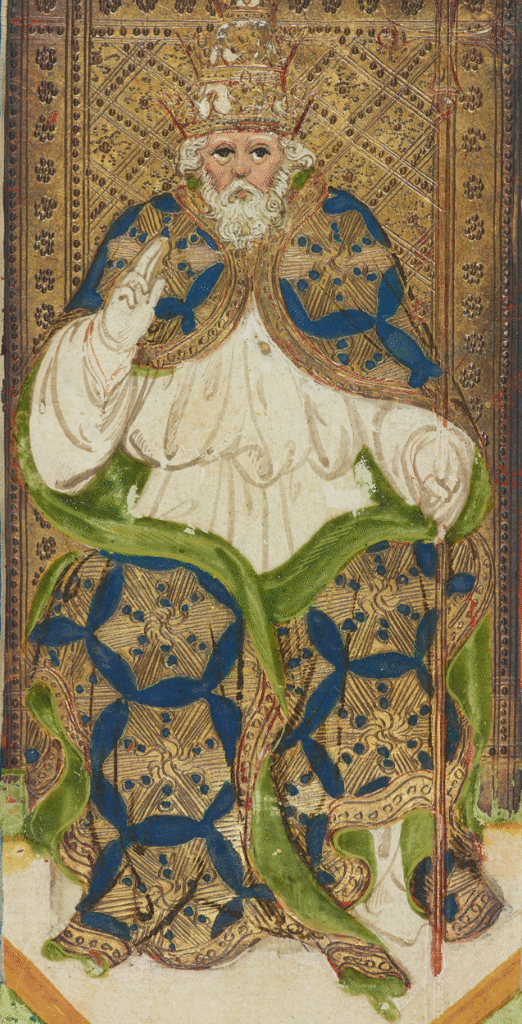
The Pope card from the 15th-century Visconti-Sforza tarot, showing a crowned figure blessing with two fingers raised.
The Pope card in the Visconti-Sforza tarot deck.
The Emperor card from the Rider-Waite tarot, a stern figure seated on a stone throne adorned with ram heads.
The Emperor card in the Rider-Waite tarot deck.

Meanings & Keywords

The Hierophant, following The Emperor, is another strong male figure. While The Emperor represents a practical force and grounded power, The Hierophant embodies a spiritual guide, a light that illuminates the path, and an ideal to aspire to. What does The Hierophant tarot card signify? Here, we will unravel its meanings in both upright and reversed positions.

Upright Meaning

The Hierophant – also referred to as the Pope – represents a mature figure with a profound spiritual awareness. This card embodies protection, moral justice, and unwavering certainty in one’s chosen path.

The Hierophant, in its upright position, serves as a beacon of guidance and wisdom, urging you to seek foundational knowledge from trusted sources. In contrast to the following card, The Lovers, which encourages individual choice and belief systems, The Hierophant signifies a phase of learning from established principles before forging your unique path.

In tarot readings, this card frequently embodies the essence of well-established societal structures and their enduring traditions. It hints at your potential involvement in ceremonies, rituals, or religious customs that hold cultural or personal significance. The Hierophant underscores the importance of conformity to existing rules and structures that have stood the test of time, advocating for a period of adherence to established norms and values.
This card encourages you to embrace the wisdom of tradition and honor time-tested rituals. It invites you to seek guidance from trusted mentors or institutions as you embark on your journey towards personal growth and spiritual enlightenment.

Upright Keywords

Wisdom – Spiritual guidance – Mature guidance – Justice – Reflection – Balance – Memories – Growth – Marriage – Teacher – Expert – Calmness – Mindfulness – Trust – Tradition – Caring – Protection – Desire to help – Support – Communication

Reversed Meaning

In the reversed position, The Hierophant card suggests a departure from established norms. This may lead to impulsiveness and the need to strike a balance between introspection and decisive action. It signifies a period where rigid adherence to tradition gives way to a desire for change and liberation.
When The Hierophant appears in reverse, it may indicate a sense of feeling confined and restricted by societal structures and rules. This confinement can lead to a loss of control and flexibility in your life. You might find yourself yearning to break free from conventions and explore unorthodox approaches. The reversed Hierophant encourages questioning established traditions and ensuring that your actions align with your current beliefs and desires.
Furthermore, this reversal signifies a moment of reflection on whether the path you’re on truly resonates with your present circumstances. It prompts you to challenge the status quo and make choices that are authentically aligned with your inner convictions. While The Hierophant traditionally represents conformity, its reversal urges you to embrace your individuality and question whether the established norms still serve your best interests in the present moment.

Reversed Keywords

Unconventional – Rebellious – Questioning tradition – Challenging norms – Independent thinking – Spirituality without institutions – Breaking free from dogma – Personal belief systems – Blocked situation – Lack of communication – Obtuseness

Key Symbols

Crown and Scepter

Within the iconic Rider-Waite Tarot deck, The Hierophant card boasts two key symbols of immense spiritual significance: the triple crown and the triple cross scepter. These symbols are discussed together due to their shared connection with the concept of the trinity.
The papal or triple crown adorning The Hierophant’s head evokes a sense of profound tradition, reminiscent of the papal tiara known as the triregnum. This three-tiered crown represents the sacred trinity, a motif echoed throughout the card. Beyond its ornate appearance, the triple crown reflects the intricate interplay between mind, body, and spirit. In parallel, it resonates with the triadic nature of human consciousness – the super-conscious, conscious, and sub-conscious states.

In the left hand of The Hierophant lies the triple cross scepter, a symbol of the Father, the Son, and the Holy Ghost – the divine trinity itself. This scepter not only signifies spiritual authority but also establishes a connection to the highest realms of faith. Tradition dictates that whatever one holds in the left hand represents dominion, reinforcing The Hierophant’s role as a spiritual guide and guardian. With its three bars, mirroring the triadic symbolism prevalent throughout this card, the scepter suggests that the seeker is on a path to mastering the harmonious fusion of mind, body, and spirit.

These two key symbols within The Hierophant card beckon us to embark on a spiritual journey, delving into the intricate tapestry of trinitarian symbolism and the profound wisdom it holds.

The raised hand

The Hierophant has one hand raised in a gesture of blessing or imparting wisdom. It signifies his role as a spiritual teacher, guiding and enlightening others through his teachings and rituals. This gesture also aligns with the concept of the trinity, as three fingers point heavenward, symbolizing the divine trinity.

The crossed keys

Two crossed keys lie at the feet of the Hierophant. These are familiar signs of the papacy, and represent the Hierophant’s ability to unlock the mysteries and secrets of the divine realms and offer guidance to those who seek it.

The crossed keys rest upon a platform adorned with four encircled crosses, known as globus cruciger, symbolizing the Earth. This arrangement mirrors the astrological sign of Venus, which is intricately linked to The Hierophant card. The Venus sign represents the union between the spiritual and the earthly, emphasizing the card’s connection to love, beauty, and the harmonious balance between the two realms. The Venus symbol is also present in The Empress card.

More Tarot Insights

Born Under a Rising Sign

The definitive book on the Ascendant is out now.
Understand your Rising Sign like never before.