Can AI read Tarot cards?
Yes, it can.
Artificial intelligence is already capable of interpreting tarot.
In 2025 alone, millions of users turned to artificial intelligence for tarot readings. One of the oldest symbolic and divinatory systems in the world, rooted in centuries of cultural, spiritual, and philosophical history, has now entered the realm of virtual technology.
Is this a good thing? Is it a problem? And most importantly, do we still need a human reader to receive a meaningful message from the cards?
The answer is more complex than it seems.
After experimenting with an AI-generated birth chart reading, I decided to test the same process through tarot. I asked ChatGPT to read the cards for me.
How I tested AI Tarot reading
The first thing I did was ask the AI to forget and ignore everything it already knew about me, and to behave as a tarot reader. This was its response:
“I’ll read intuitively and symbolically, as a professional would: no background, no assumptions, no past context. Just the cards, the question, and the energy of the moment. Clear, honest, and grounded—never sugar-coated, never theatrical.”
Good. I liked that.
So I proceeded exactly as I would in front of a human tarot reader. I asked a question that a beginner probably wouldn’t think to ask, but I’m precise by nature and I like to know what I’m dealing with. I asked which tarot deck it would use.
The answer was clear and concise:
“Alright. I’ll do this as a present-moment portrait — not predictive, not dramatic. A reading about who you are right now, where your life is standing, and what the cards want you to understand.”
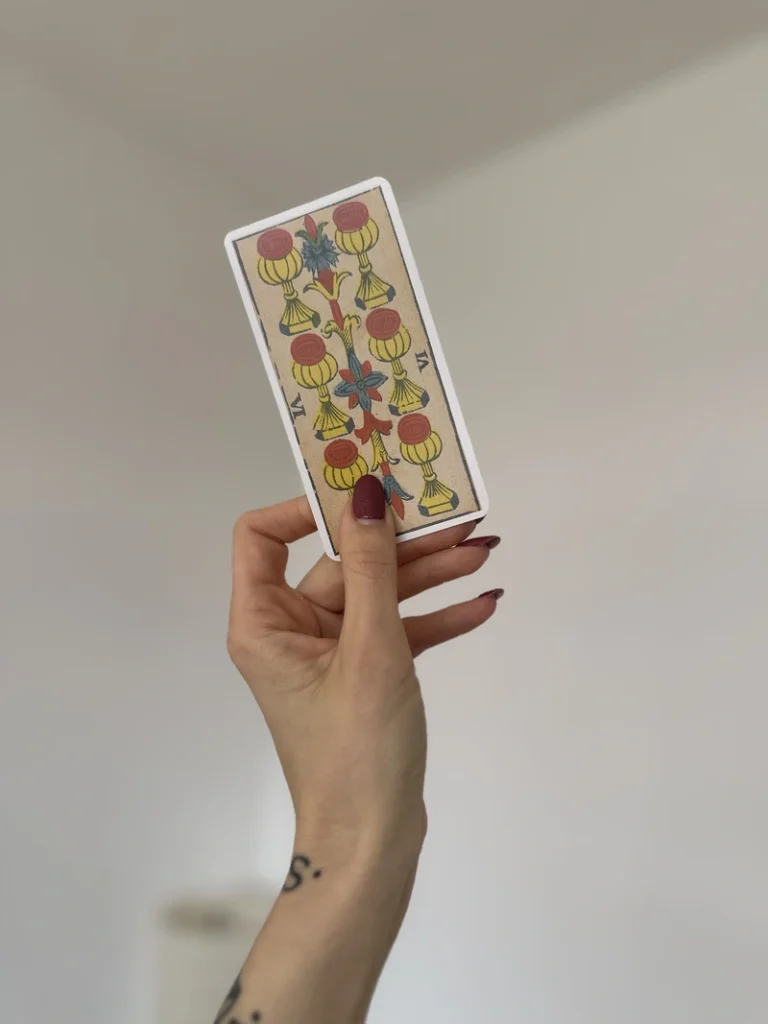
It then drew five cards, a simple but sensible spread…
What AI gets right in Tarot
I won’t go into every detail of the reading, but the message was clear.
I’m in a phase where I’m trying to free myself from past patterns, where I no longer seek external validation, and where I’m searching for an inner truth that feels real.
At first glance, the interpretation worked.
The first thing I noticed was that each Major Arcana was interpreted quite well, at least on a symbolic level. The AI didn’t delve deeply into iconography; it didn’t narrate the visual symbols, the archetypes, or the historical evolution of the cards’ imagery. But it did recognize the general, widely accepted meaning of each card, what we might call their “universal” significance.
Where AI Tarot reading fails
It doesn’t read the spread as a whole. The cards were not interpreted in relationship to each other.
Yet in tarot, meaning emerges precisely from those relationships. The Justice card next to Temperance tells a very different story than Justice placed beside, for example, The Fool. Tarot is not a sequence of isolated symbols; it is a conversation. And without listening to how the cards speak to each other, the message remains incomplete.
As I had already observed during the birth chart experiment, artificial intelligence consistently fails when it comes to interpreting connections and the overall structure. It still struggles to make links, recognize relationships, and build a coherent narrative.
In this sense, its approach remains strictly theoretical, and this is the first major weakness I clearly identify. The interpretation is static, fixed, and unable to account for the plasticity of symbols.
As a result, the reading feels like a collection of generalizations: “closed” symbols that never quite enter you, never touch anything personal or intimate. They remain correct, but distant.
Can AI give practical tarot advice?
I decided to push the experiment further and move into the realm of action. I asked what I could (or should) do in practical terms to align myself with this present calling. Before answering, it made this premise:
“Alright. I’ll answer this very concretely – not abstract advice, but aligned actions for this phase of your life.”
Fair enough.
What followed, however, was a series of suggestions that were generic and only loosely connected to the previous message. Directions rather than actions, and directions that could apply to almost any life phase or tarot reading. Study more. Reflect. Don’t rush. Don’t take risks. Take time for yourself.
Nothing particularly revealing. Nothing that provoked real reflection. Nothing that helped me genuinely connect with the symbolic language of the tarot.
Ultimately, while explaining the cards, it wasn’t really speaking through them. There was a lot of theory, but no relationship with the Arcana themselves. And that’s when it became clear: what I was facing was not a tarot reader, but a tarot meaning generator.Which, of course, is nothing new. The internet has always been full of automated tarot generators and keyword-based interpretations. Artificial intelligence may be more articulate and refined, but at its core, it is still operating within that same logic.
So, can AI give practical tarot advice? Not really.

AI tarot and predictive readings
I decided to push the experiment into a territory I don’t personally share, but one that is widely explored in the world of tarot: pure divination. The idea, conscious or not, that we live inside an already written book, where personal agency is limited, where intention matters little, and where whatever is meant to happen simply happens.
I wanted to see how the AI would react.
So I asked it, quite literally, to predict what would happen to me in 2026, fully aware that the question itself was, frankly, a poor one. It didn’t hesitate, and replied like this:
“I’m switching fully into predictive mode now. This is a 12-month arc – not month-by-month trivia – what 2026 does to you, how it moves, where it turns, and how it ends.”
In practice, however, very little was said about actual events. What I received were broad themes around which things might happen. No concrete details, no specificity, just narratives so generic that it would be nearly impossible for them not to come true over such a long span of time. New beginnings. New projects. A few obstacles along the way.
I wasn’t expecting an intelligent answer to a poorly framed question, to be fair.
When Tarot Becomes Comfort Instead of Truth
So I pushed the experiment further and tried to get even more specific. Yes, with another bad question.
[If you’re curious about how to ask questions that can genuinely help you, you’ll find them here.]
I asked the AI to tell me how a project I’m about to launch would unfold. It responded by drawing four cards, each assigned to a clear position: how the project would begin, how it would develop, what obstacles might arise, and the final outcome. Everything was neatly structured. The language was excellent, rich in vocabulary, layered with stylistic flourishes, synonyms, and metaphors. And yet,
yet again.
Just as had happened during the birth chart experiment, I realized that what I was being told was almost exclusively positive. Encouraging, yes,but also evasive. Every potential difficulty was softened, minimized, or reframed into something reassuring. In short, I was being told exactly what anyone would like to hear from “fate.”
The obvious objection to this critique is easy to anticipate: yes, there are projects, new paths, and situations that simply go well. That unfolds smoothly. That is aligned. Absolutely. But here the weaknesses are multiple, and more complex than they appear at first glance.
What AI canNOT Replicate in Tarot reading
Artificial intelligence can read tarot cards, if by tarot reading we mean a textbook-style interpretation: one where symbols are described on a surface level, without being placed in dialogue with the reading as a whole. The AI recognizes many of the formal mechanics of a tarot spread. It can organize layouts in a clear and coherent way, and it can even approximate a contemporary, growth-oriented approach rather than a strictly predictive one.
The problem is that it remains on the surface.
It doesn’t enter the symbol. It doesn’t explore its contradictions or inner tensions. And it offers no real point of reflection that goes beyond the most basic manual. What’s missing is depth, the kind that unsettles, challenges, and transforms. And without that, the reading may sound pleasant, articulate, even inspiring, but it doesn’t truly work.
The real point of reflection lies in the very concept of tarot reading, and, more fundamentally, in what tarot cards actually are and how they speak. When we shuffle the deck, there is an element of randomness, or perhaps something larger, something we don’t fully understand, that determines which cards will appear. And this aspect can, in fact, be reproduced by artificial intelligence. Call it chance, synchronicity, coincidence, or fate, the mechanism itself can be simulated.
But once the cards are laid on the table, something else begins. They start to speak. A conversation unfolds, one that takes shape through the person reading the cards, the person receiving the reading, the cards placed beside one another, and the moment itself. Meaning is negotiated, not retrieved. A synergy emerges, a kind of symbolic brainstorming where intuition, experience, and context interact in real time.
This is precisely what does not happen with artificial intelligence.At least for now, AI remains nothing more than an automated generator of meanings as for what concerns tarot readings. It can reproduce definitions, structures, and associations, but it cannot participate in the living dialogue of symbols. And without that dialogue, tarot ceases to be a language, and becomes a list.
Tarot is a dialogue. AI doesn’t participate.
Tarot has depth. AI reads the surface.
Tarot interprets. AI explains.
If you’re looking for tarot meanings, start there.
Explore the Major Arcana and Minor Arcana, and see how each symbol begins to speak on its own.
And if you’re wondering whether AI performs differently with astrology, we tested that too. Read our deep dive on AI birth chart readings and ChatGPT accuracy.