In our previous article on astrology in the Renaissance art, we explored how Marsilio Ficino and some thinkers of the time reimagined the cosmos as a symbolic language – one where the stars shaped both art and soul. Here, we dive into one of its most iconic expressions: Botticelli’s Venus.
More than myth, more than beauty, she is a mirror of the cosmos, painted with the brushstrokes of philosophy, desire, and divine harmony.
Botticelli and the Art of Invisible Forces
Sandro Botticelli, a Florentine painter who lived between 1445 and 1510, was one of the greatest artists of the Early Italian Renaissance. He came into contact with the philosophical work of Marsilio Ficino through his close relationship with the Medici family, renowned patrons of the arts, who commissioned many of his masterpieces.
This connection deeply influenced Botticelli’s artistic vision, infusing his works with layers of symbolic meaning, mythological references, and a refined spiritual aesthetic.
Through his art, Botticelli gave form to the invisible: the movement of the soul, the influence of the stars, the divine intelligence flowing through nature. His figures are both earthly and ethereal, timeless and suspended, visual embodiments of a world where astrology, philosophy, and beauty were deeply intertwined.
Many of Botticelli’s works reflected the Neoplatonic teachings that the philosopher Marsilio Ficino was imparting to his student, Lorenzo de’ Medici. Through this intellectual atmosphere, Botticelli came to interpret ancient myths not merely as stories, but as moral lessons for contemporary life.
In his paintings, classical legends are transformed into symbolic narratives, where beauty is not just physical, but spiritual; where every gesture, flower, or gaze carries deeper meaning. Influenced by Ficino’s belief that the soul could ascend toward the divine through contemplation of beauty, Botticelli used myth as a vehicle for reflection.
The Birth of Venus by Botticelli
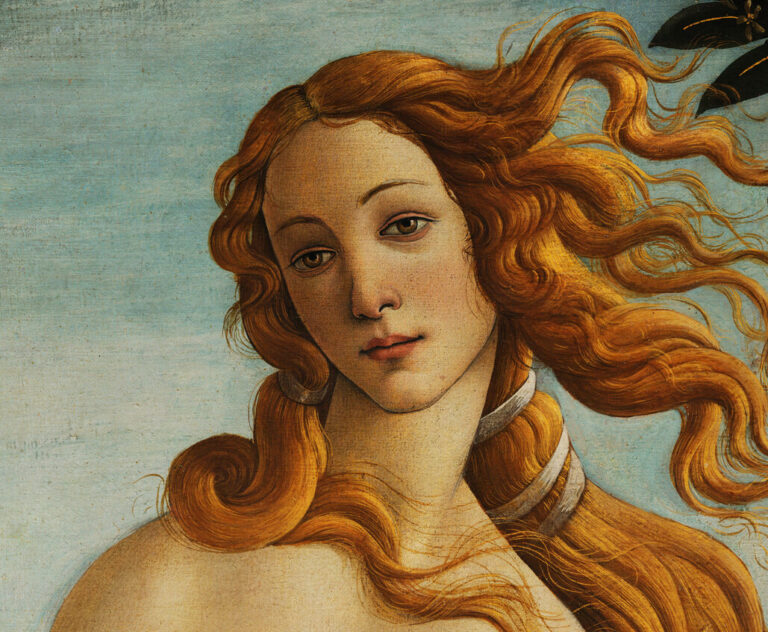
In The Birth of Venus, painted between 1485 and 1486, we see the classical myth brought to life, the story in which Venus is born from the sea foam and carried to shore atop a giant scallop shell.

Botticelli captures this moment of divine emergence with extraordinary grace. Venus stands at the center of the composition, nude yet unashamed, embodying a beauty that is both sensual and ethereal. She personifies harmony, proportion, and ideal love – not merely a woman, but a cosmic force. The wind gods Zephyrus and Aura gently blow her toward the land, where a figure representing Spring waits to clothe her with a flower-covered mantle. Every detail is charged with symbolism: the roses scattered in the air, the stillness of the sea, the stylized waves, all contribute to the timeless, dreamlike quality of the scene.
This is not just a mythological moment, but a visual expression of Neoplatonic philosophy. For Marsilio Ficino and the thinkers of the Renaissance, Venus represented divine beauty, a gateway through which the soul could rise toward the divine. Botticelli’s Venus is not carnal; she is transcendent. The Birth of Venus is therefore more than a celebration of physical beauty; it is a visual hymn to spiritual awakening, to the idea that through beauty, one may glimpse eternity.
The Secret Astrology Hidden in Botticelli’s Venus
In this depiction of Venus, there is more than mythology. There’s something deeper: a symbol shaped through the lens of astrology.
Botticelli’s Venus moves beyond the detached, classical ideal of beauty; she becomes human, not by losing her divinity, but by embodying something timeless within us.
She is no longer merely a goddess of myth, but a universal force: the longing for harmony, the attraction toward beauty, the power of love as a transformative principle.
Just as the planets in astrology are not merely celestial bodies but symbolic reflections of inner dynamics, Venus in this painting becomes the visual expression of a psychological truth.
She represents the part of us that seeks connection, aesthetic order, emotional resonance, that draws us toward others and toward ourselves through grace, desire, and the pursuit of balance.
In this way, Botticelli’s Venus is not just a goddess from the sea, she is the birth of beauty within the soul, the awakening of a deep, timeless part of the human experience. A mirror through which we can recognize the divine not as something distant, but as something that lives quietly within.
Venus as Archetype: The Soul’s Deepest Mirror
In The Birth of Venus, beauty is elevated to something greater, it becomes Platonic. It is no longer about physical perfection, but about love in its highest, most enduring form. This is the kind of beauty that doesn’t belong to the senses alone, but to the soul. It is the love that elevates, that reveals the divine through the visible, that awakens in us a longing for truth, for unity, for something beyond the material world.
Botticelli’s Venus is not a celebration of the surface, she is a symbol of the eternal. In her stillness, her serenity, and the purity of her presence, we glimpse the Platonic idea that true beauty is a reflection of love itself: the force that binds, inspires, and connects all things.
And if we begin with astrology, we inevitably return to it, because this is precisely the archetype of the planet Venus. This is what Venus represents in a birth chart: not mere predictions or vague notions of innate beauty without substance, but the deep, symbolic expression of how we love, how we attract, how we relate to harmony and value.
Venus in astrology speaks of the ways we seek connection, emotionally, aesthetically, and spiritually. It reveals our capacity to create beauty in our lives, not as an external ideal, but as a reflection of what we cherish, what we desire, and how we experience pleasure and intimacy. It’s not about perfection, it’s about resonance. Venus is the part of the psyche that teaches us to recognize the sacred in what moves us, to value what feels aligned with who we truly are, and to build relationships, with others and with the world, that reflect our inner sense of grace and meaning.

Venus Reimagined: Beauty as a Bridge Between Worlds
The Venus painted by Botticelli is not the Venus of mythology, not the distant, untouchable ideal of feminine beauty, divine and unreachable. She is the astrological Venus, the one Marsilio Ficino identified as the symbol that holds all things together, a unifying force that descends from the heights of the heavens and takes root within us. This Venus is not static. She evolves, transforms, and continues to grow. She is the expression of a living archetype, not an image frozen in perfection, but a dynamic presence that moves through our desires, our values, our ability to love and create harmony.
In this interpretation, Botticelli’s Venus becomes a bridge between the cosmic and the human. She represents the inner flame that draws us toward beauty not for its own sake, but as a path to self-knowledge and connection.
Venus, the Eternal Invitation
Botticelli’s Birth of Venus is more than a masterpiece. It’s an invitation. An invitation to remember that beauty is not superficial, but spiritual. That love is not fleeting, but cosmic. And that within each of us lives a Venus: an archetype of connection, grace, and the quiet power of attraction.
To look at her is to remember what it means to be moved, not just by art, but by the soul’s desire to unite with something greater.
Want to uncover more about the astrological archetypes that still shape us today? Follow @born_under_saturn_ on Instagram for poetic horoscopes, cosmic insights, and the soul of astrology – alive in art, myth, and You.
Or return to the beginning of this journey with our article on Astrology and the Renaissance, where the cosmos first began to whisper through paint and philosophy.