For centuries, tarot cards have moved between worlds.
Born as a refined game among Renaissance elites, they later became a symbolic language, a mirror of the psyche, and a tool for divination.
In 2026, they return to where their story began.
At Accademia Carrara in Bergamo, one of Italy’s most important art museums, a major exhibition brings together the history, artistry, and cultural evolution of tarot in a way rarely seen before.
A Rare Tarot Exhibition in Italy
From February 27 to June 2, 2026, Accademia Carrara hosts Tarocchi. Le origini, le carte, la fortuna, curated by Paolo Plebani.
This is not just another thematic exhibition. It is one of the most extensive projects ever dedicated to tarot, tracing its development across seven centuries, from the 15th century to contemporary interpretations.
What makes this exhibition particularly significant is not only its scope, but its intent: to reposition tarot within the history of art, rather than limiting it to esotericism.
The Reunion of the Colleoni Tarot Deck
At the heart of the exhibition lies an extraordinary event.
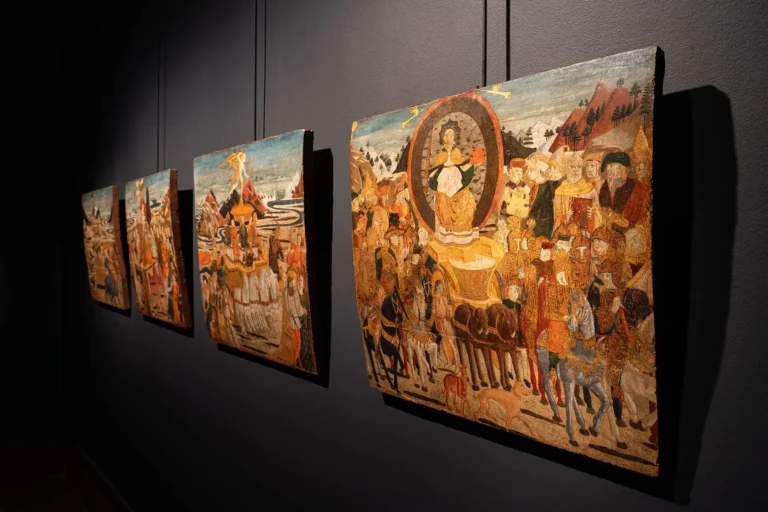
For the first time in over a century, 74 cards from the Colleoni Tarot deck are reunited. Considered one of the most complete surviving early tarot decks, these cards are usually divided between institutions such as Accademia Carrara, The Morgan Library & Museum in New York, and private collections.
Bringing them together again is not just a curatorial achievement. It offers a rare opportunity to observe tarot as it originally existed: not fragmented, but as a coherent visual system.
This alone would justify the visit.
From Courtly Game to Symbolic Language
One of the most interesting aspects of the exhibition is how clearly it traces the transformation of tarot.
Originally created as a luxurious pastime for aristocratic courts, tarot decks were objects of craftsmanship and status. With the spread of printing technologies, they became more accessible, gradually entering popular culture.
Only later, around the 18th century, did tarot begin to take on its divinatory dimension. This shift is essential to understand. It challenges a common assumption: that tarot was “always” mystical. In reality, its symbolic power evolved over time, shaped by culture, philosophy, and artistic movements.
If you want to explore this evolution more deeply, you can read our full guide on the history of tarot.
Art, Artists, and Interpretations
The exhibition moves beyond historical reconstruction and explores tarot as an artistic language.
From the refined Renaissance imagery of Bonifacio Bembo, linked to early Italian tarot production, to modern reinterpretations influenced by Surrealism, the journey highlights how tarot has continuously inspired artists across centuries.
Figures such as Victor Brauner, Leonora Carrington, and Niki de Saint Phalle demonstrate how tarot imagery has been reimagined in contemporary art, blending mythology, psychology, and personal symbolism.
Even photography enters the conversation, with works by Irving Penn showing how tarot can transcend medium while preserving its archetypal core.
International Collaborations
The scale of the exhibition is made possible through collaborations with major international institutions.
Among them are The Morgan Library & Museum in New York, the Bibliothèque Nationale de France in Paris, the Beinecke Rare Book and Manuscript Library at Yale University, and the National Library of Florence.
These partnerships reinforce an important point: tarot is not a marginal curiosity, but a cultural artifact recognized across the world.
Why This Exhibition Matters (and Who Should Visit)
If you’re interested in tarot, this exhibition offers something rare: context.
Not interpretations, not spreads, not readings—but origins.
It allows you to see tarot before it became what we think it is today. And in doing so, it subtly changes how you understand it.
However, it’s also worth questioning another assumption: does seeing historical decks actually deepen your personal relationship with tarot?
For some, yes. For others, tarot lives more in practice than in history.
This exhibition leans strongly toward the intellectual and artistic dimension. If you’re looking for a spiritual experience, you may not find it directly here—but you might leave with a more grounded understanding of the symbols you use.
Plan Your Tarot Journey in Italy
Bergamo is not the only destination for tarot lovers.
If you’re planning a trip, you can explore a wider route through symbolic and tarot-related places across the country in our tarot itinerary in Italy: