
Many people read their horoscope every day, but very few actually know how to read a horoscope correctly. Why do some horoscopes feel incredibly accurate while others seem completely wrong?
This confusion often leads to the same questions: Are horoscopes actually real? Are they accurate? And should we read our horoscope for our Sun sign, our Moon sign, or our Rising sign?
In astrology, a horoscope is not a random prediction but an interpretation of planetary movements in relation to the zodiac signs. Astrologers observe how current planetary transits interact with each sign and translate those patterns into symbolic guidance.
In this guide, you will learn how to read your horoscope correctly, why the Rising sign often matters more than the Sun sign, and why horoscopes can sometimes feel surprisingly accurate.
Are Horoscopes Actually Real?
In astrology, horoscopes are not random predictions but interpretations of planetary movements and their symbolic meaning. They describe patterns of time rather than fixed events, offering insight into the themes that may unfold during a certain period.
The question of whether horoscopes are real often comes from a misunderstanding of what astrology actually does.
To answer this question honestly, it helps to start with science. Science does not consider horoscopes to be real, factual, or supported by empirical evidence. As Sofia Quaglia explains in an article for BBC Earth, “There is no scientific backing to the conclusions drawn by astrology.”
However, this answer only applies if we assume astrology is meant to function like a natural science. Historically, astrology was never intended to predict events in a laboratory sense. Rather, it developed as a symbolic language describing the rhythms of time and the relationship between cosmic cycles and human experience.
In fact, in the same article for BBC Earth, Quaglia adds: “But there are many ways that astrology is connected with the human world, as it’s intertwined with the pursuit of knowledge about our place in the cosmos.”
In other words, horoscopes (and Astrology itself) may not function as a predictive science, but as a symbolic system through which human beings have long tried to understand their relationship with time, nature, and the cosmos.
Horoscopes, then, are as real as a painting and the emotions it evokes. Their symbolism, their cathartic power, and their ability to enter into dialogue with the factual world give them meaning. They do not prove reality in the empirical sense, but they reveal patterns through which human experience can be interpreted.
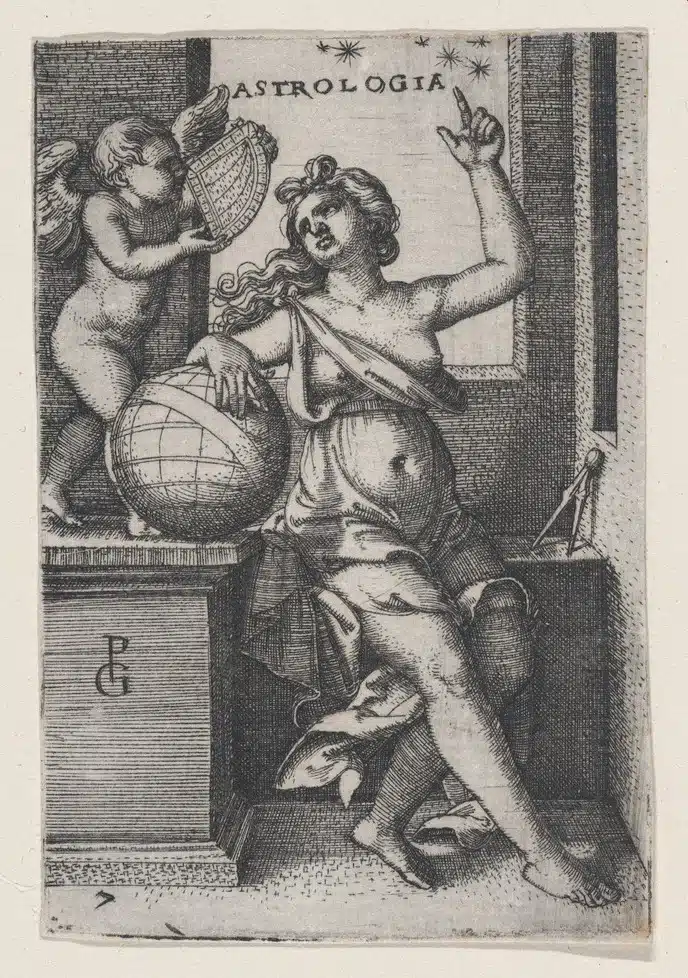
Georg Pencz German
What Horoscopes Are Based On in Astrology
Horoscopes are based on the movement of the planets through the zodiac.
Astrologers observe how the Sun, Moon, and planets travel across the twelve zodiac signs and interpret the symbolic patterns created by these movements. These interpretations are then translated into the horoscope predictions that describe the atmosphere of a particular moment in time.
In practice, most horoscopes are written by observing planetary transits, the current position of the planets in the sky, and how these positions interact with each zodiac sign. By translating these cosmic cycles into symbolic language, astrologers describe the themes, tensions, and opportunities that may emerge during a certain period.
The Different Types of Horoscopes: Daily, Weekly, Monthly, and Yearly
There are several types of horoscopes: the daily horoscope, the weekly horoscope, the monthly horoscope, and the yearly horoscope. Each astrologer has their own method, but in general these forecasts are based on different planetary cycles depending on the time frame being interpreted.
Daily horoscopes are often influenced primarily by the Moon, as it is the fastest-moving luminary and closely linked to short-term emotional and atmospheric shifts, the rhythm of everyday time, so to speak.
Weekly horoscopes tend to consider the movements of the faster planets, such as Mercury, along with the Moon and other relevant planetary aspects.
Monthly horoscopesusually adopt a broader perspective, observing the larger configurations forming in the sky during that period.
Yearly horoscopes, on the other hand, take the widest view of all, focusing especially on the slow-moving planets whose cycles shape longer phases of life and collective experience.
Why Horoscopes Are Written for Zodiac Signs
Horoscopes are usually written for zodiac signs because astrology observes how planetary movements interact with each sign of the zodiac. When astrologers write “the horoscope for Aries,” they are describing how the current positions of the planets form aspects and relationships with the sign of Aries.
In practice, this means interpreting how planetary transits activate certain symbolic themes connected to that sign. These aspects, such as conjunctions, squares, trines, or oppositions, create the energetic patterns that astrologers translate into horoscope predictions.
Why Horoscopes Can Feel Both General and Accurate
Horoscopes are often perceived as generic because they are written for entire zodiac signs rather than for individual birth charts. Each zodiac sign represents millions of people, which means a horoscope must describe symbolic themes that may resonate broadly rather than predict specific events.
However, this does not mean horoscopes are fake or random. When astrologers write a horoscope for a zodiac sign, they are interpreting how current planetary transits interact with the symbolic structure of that sign. These movements often create shared emotional or psychological themes that many people experience at the same time, in a different way.
General Horoscopes vs Personal Astrology
General horoscopes are written for entire zodiac signs. This means that a single horoscope must describe themes that may resonate with millions of people who share the same Sun sign.
The real precision of astrology emerges when planetary movements are interpreted in relation to an individual birth chart. In this case, the same transits are read through the unique positions of the planets at the moment of birth, allowing astrology to describe much more personal patterns and experiences.
In this sense, general horoscopes describe the atmosphere of time, while personal astrology explores how that atmosphere is experienced by a specific individual.
So, does it really make sense to read a general horoscope online, such as our daily horoscopes written for each zodiac sign? In many ways, it does.
A general horoscope does not attempt to describe the unique details of an individual life. Instead, it reflects the broader atmosphere of time, the symbolic patterns created by the movement of the planets through the zodiac.
This means a general horoscope works less like a precise prediction and more like a map of the weather of time. Just as many people experience the same storm or the same sunlight in different ways, planetary movements create shared emotional and symbolic climates that can resonate across many lives.
Reading a horoscope, then, is not about expecting exact events to unfold. It is about recognising the qualities of the moment you are moving through. And when approached in this way, even a general horoscope can become a meaningful tool for reflection, awareness, and interpretation of the time we are living in.
How to Read Your Horoscope the Right Way
There is indeed a right and effective way to read a horoscope, one that allows it to truly help us navigate what astrology has often been described as a fascinating “science of time.” The first thing that matters is the approach. Our approach.
A general horoscope, the kind divided by zodiac signs, should not be read in search of the answer to the question “What will happen?” Instead, it is far more meaningful to read it with a different question in mind: “How?” Not how events will unfold in a literal sense, but how the quality of time may express itself, through moods, opportunities, tensions, or shifts in awareness.
Sun Sign or Rising Sign: Which Horoscope Should You Read?
One of the most common questions people ask is whether they should read their horoscope for their Sun sign or their Rising sign.
The most technically accurate answer, the one often considered “by the book”, is that the most precise way to read a horoscope is through your Rising sign, also known as the Ascendant. But why is that?
The answer is both simple and technical. In astrology, the Rising sign determines the structure of the birth chart and establishes the sequence of the twelve houses. Each house corresponds to a specific area of life, relationships, work, home, creativity, and so on.
When horoscopes are written, astrologers interpret how the current movements of the planets interact with these houses. Because the Rising sign defines where each house begins, reading the horoscope from the perspective of the Ascendant allows those planetary transits to align more precisely with the areas of life they are meant to describe.
Imagine that a horoscope says: “This week, an important planetary transit activates themes related to career, direction, and public visibility.” If you read the horoscope for your Rising sign, this statement may correspond to the area of life associated with the tenth house, the sector traditionally linked with work, ambitions, and one’s role in the world.
Because the Rising sign determines the structure of the houses in the birth chart, the horoscope can describe more precisely which sphere of experience is being activated by the planetary movement.
If the Rising sign plays such a central role in understanding horoscopes, it becomes clear why it is considered one of the most important elements of the birth chart.
For readers who wish to explore this dimension more deeply, the Rising sign is the focus of the book Born Under a Rising Sign, where each Ascendant is examined as a symbolic doorway into personality, perception, and the way we move through the world.

Why Reading Your Sun Sign Horoscope Still Makes Sense
Even though astrologers often recommend reading horoscopes through the Rising sign, the Sun sign still plays an important role. The Sun represents the core of identity, the central principle around which personality develops.
It is true that reading the horoscope through the Rising sign gives a more precise indication of the area of life activated by current planetary transits. If Mercury, for example, is moving through Aries and you have Libra Rising, this means probably that Mercury is activating your seventh house. By reading the horoscope for Libra, you will often find this reference reflected quite accurately.
At the same time, astrology is never based on a single symbol. It is a system of interconnected symbols, each one contributing to the overall meaning of the chart. The Rising sign, the Sun, the Moon, and the planets all participate in the same symbolic language, working together to describe the many layers of human experience.
In this sense, reading a horoscope through the Sun sign alone is neither wrong nor incomplete. The most meaningful approach, as we often suggest, especially when reading our monthly horoscopes, is to consider all three: the Rising sign, the Sun sign, and the Moon sign.
Looking at these three together offers a more holistic perspective, allowing the horoscope to be understood through multiple layers of experience: the structure of life described by the Rising sign, the core identity represented by the Sun, and the emotional landscape symbolized by the Moon.
This broader view reflects the true nature of astrology, which is never built on a single symbol but on the dialogue between many.
Explore Our Horoscopes: Daily, Weekly, Monthly, and Yearly
Now that you know how horoscopes work and how to read them in a more meaningful way, you can explore them with a different perspective.
Below you will find our horoscopes organised by time frame, from daily reflections to broader yearly cycles. Each forecast is written to help you observe the symbolic movements of time and understand how planetary transits may shape the atmosphere of a particular moment.