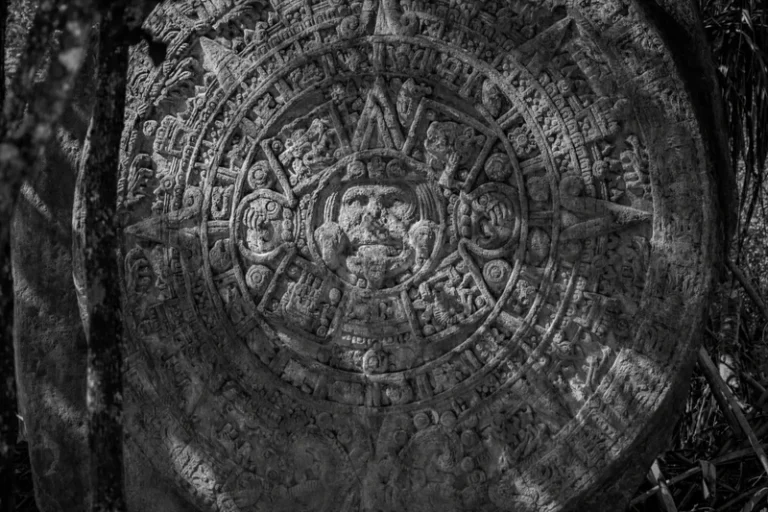
Mayan astrology offers a different way to understand who you are. It does not follow the familiar zodiac path.
Unlike Western astrology, which follows the Sun through twelve zodiac signs each year, it uses the sacred Tzolkin calendar. This calendar reflects a more fluid and symbolic view of time. Instead of months and seasons, it works through repeating energies, each carrying a specific meaning and direction.
Your Mayan astrology sign depends on your birth date in this cycle. It shows parts of your personality and deeper patterns.
In this article, you will discover your Mayan astrology sign using our calculator and explore what it reveals about you. You will also learn how this ancient system works and how it differs from Western astrology.
Find Your Mayan Astrology Sign (Calculator)
Here, you can discover your true Mayan astrology sign based on the Tzolkin, the sacred 260-day Mayan calendar.
Unlike simplified versions that focus only on animal symbols, our calculator combines twenty day signs and thirteen tones, offering a more precise and meaningful reading. Let’s go!
Mayan Astrology Sign Calculator
Enter your birth date to discover your Mayan sign and number.
Now that you know your Mayan astrology sign, you can explore its meaning below. In this system, your sign is made of two parts: a day sign (with its name) and a number, known as a tone. Together, they describe not only the quality of your energy, but also how it expresses itself within the cycle.
Mayan Astrology Signs and Their Meanings
The Mayan calendar is a complex system based on the symbolic significance assigned to each day within the Tzolkin cycle.
Here, you’ll find the meaning of your specific sign. Continue to read the article for a deeper explanation of this ancient tradition: it will help you fully understand how it works and what it reveals about you.
Imix (Crocodile)
Imix is the beginning, the origin, the place where life takes form.
If you were born under this sign, you carry a deep, instinctive sensitivity. You often feel things before you understand them, and your connection to emotions, your own and others’, runs deep. There is something nurturing in you, but also something raw, almost untamed. Learning to trust your intuition without being overwhelmed by it is part of your path.
Ik (Wind)
Ik is breath, movement, and the invisible force that connects everything.
You are naturally expressive, even when you don’t try to be. Words, ideas, and thoughts move quickly through you, and you often feel the need to communicate, to share, to make sense of things out loud. At times your mind may feel restless, but this same energy makes you a bridge between people, ideas, and perspectives.
Akbal (Night)
Akbal is the night, the inner world, the quiet space where things take shape unseen.
You live deeply within yourself. Your thoughts are rich, layered, and often hidden from others. There is a natural introspection in you, and a sensitivity to what is not immediately visible. You may need solitude more than most, not as an escape, but as a way to reconnect with your inner clarity.
Kan (Seed)
Kan is the seed, the potential that waits to grow.
You carry something inside you that is meant to develop over time. Growth is not always immediate in your life, but it is constant. There is a quiet strength in your ability to evolve, to transform, and to become. Trusting your own timing is essential.
Chicchan (Serpent)
Chicchan is life force, instinct, and the intelligence of the body.
You feel life physically, not just mentally or emotionally. There is a strong connection between your instincts and your actions, and you often know what is right without needing to explain it. Your energy is intense, sometimes overwhelming, but it is also deeply alive.
Cimi (Death)
Cimi represents endings, but also the quiet beginning that follows.
You are familiar with change, even when you don’t choose it. There is something in your life that asks you to let go, again and again, and through this you develop a rare strength. You understand that transformation is not loss, but movement.
Manik (Deer)
Manik is balance, stability, and a deep connection to the natural world.
You tend to seek harmony, both within yourself and around you. There is a grounded quality in your presence, something calm and reassuring. Others may rely on you more than you realize, because you naturally create a sense of stability.
Lamat (Rabbit / Star)
Lamat is beauty, abundance, and the energy of multiplication.
You are drawn to what grows, expands, and shines. There is a creative, sometimes magnetic quality in you, and a natural connection to pleasure, aesthetics, and expression. When you are aligned, things tend to flow toward you.
Muluc (Water)
Muluc is emotion, flow, and the act of offering.
You feel deeply, and your emotional world is central to how you move through life. There is generosity in you, but also a need to protect your own energy. Learning when to give and when to hold back is key.
Oc (Dog)
Oc is loyalty, connection, and unconditional presence.
Relationships matter deeply to you. You are someone who shows up, who stays, who cares. There is warmth in your way of being, but also a need for reciprocity. You thrive in genuine, honest bonds.
Chuen (Monkey)
Chuen is creativity, play, and the art of expression.
You see life as something to be shaped, explored, even reinvented. There is curiosity in you, and a natural ability to create meaning through what you do. At times, you may resist structure, but your freedom is also your strength.
Eb (Road)
Eb is the path, the journey, the unfolding of life.
Your life is not static. You are here to move, to experience, to evolve. There may be moments of uncertainty, but they are part of your direction. Trusting your path, even when it changes, is essential.
Ben (Reed)
Ben is structure, alignment, and inner authority.
You often feel the need to stand straight, to do things the right way, to create order. There is a strong sense of integrity in you, but also pressure. Learning to soften without losing your direction is part of your balance.
Ix (Jaguar)
Ix is intuition, mystery, and quiet power.
You move through life with depth and awareness. You notice what others miss, and you often prefer observing to reacting. There is something private in you, almost sacred, that not everyone gets to see.
Men (Eagle)
Men is vision, perspective, and higher awareness.
You have the ability to see beyond the immediate. You often understand situations from a distance, with clarity. There is wisdom in your perspective, even if you sometimes feel disconnected from the present moment.
Cib (Wisdom / Owl)
Cib is knowledge, memory, and understanding.
You learn through experience, and you carry what you learn deeply. There is reflection in you, and a desire to make sense of things on a deeper level. You are not superficial, and you are not meant to be.
Caban (Earth)
Caban is movement, growth, and the living earth.
You are constantly evolving. Even when things seem still, something within you is shifting. There is a connection to change, to cycles, to movement that never fully stops.
Etznab (Flint)
Etznab is truth, clarity, and sharp awareness.
You see things as they are, sometimes more clearly than others. There is honesty in you, but also intensity. Your challenge is to express truth without cutting too deeply.
Cauac (Storm)
Cauac is transformation through intensity.
You feel things strongly, and your life may move in waves. There is chaos at times, but also renewal. You are someone who transforms through experience, not by avoiding it.
Ahau (Sun / Lord)
Ahau is light, completion, and full expression.
There is something radiant in you, even when you don’t try to show it. You are drawn to clarity, to truth, to being fully yourself. Your path often leads toward awareness and self-realization.
Below, you’ll find a summary table of the Mayan day signs and their core symbolic meanings. You can use these keywords as a starting point for your interpretation and to connect more intuitively with your sign.
| Day Sign | Symbol | Meaning |
|---|---|---|
| Imix | Crocodile | Beginnings, instinct, nourishment, primal life force. |
| Ik | Wind | Breath, communication, inspiration, movement. |
| Akbal | Night | Dreams, inner world, mystery, introspection. |
| Kan | Seed | Potential, growth, fertility, unfolding power. |
| Chicchan | Serpent | Vitality, instinct, transformation, life force. |
| Cimi | Death | Release, endings, renewal, transformation. |
| Manik | Deer | Harmony, healing, steadiness, connection to nature. |
| Lamat | Rabbit / Star | Beauty, abundance, creativity, multiplication. |
| Muluc | Water | Emotion, flow, offering, purification. |
| Oc | Dog | Loyalty, love, trust, companionship. |
| Chuen | Monkey | Play, art, curiosity, creative intelligence. |
| Eb | Road | Life path, movement, journey, destiny. |
| Ben | Reed | Structure, authority, alignment, leadership. |
| Ix | Jaguar | Intuition, mystery, quiet power, spiritual depth. |
| Men | Eagle | Vision, awareness, clarity, higher perspective. |
| Cib | Owl / Wisdom | Knowledge, memory, forgiveness, ancestral insight. |
| Caban | Earth | Movement, evolution, natural cycles, growth. |
| Etznab | Flint | Truth, clarity, revelation, sharp perception. |
| Cauac | Storm | Intensity, renewal, emotional release, rebirth. |
| Ahau | Sun / Lord | Light, consciousness, fulfillment, wholeness. |
The 13 Tones in Mayan Astrology
In the calculator above, you received a Mayan astrology sign along with a number, known as a tone. While the day sign describes the core quality of your energy, the tone defines how that energy expresses itself, its rhythm, direction, and purpose within the cycle.
Below, you can explore the meaning of each of the thirteen tones to better understand how your sign takes shape and moves through your life. Pair this meaning with the one of the sign and you have got your Mayan Astrology picture!
Tone 1 – Initiation and Intention
Tone 1 is the beginning of the cycle, the moment where something takes form.
If this is your tone, you are often driven by an inner impulse to start, to initiate, to move toward something new. Even when the path is unclear, you feel the need to set things in motion. There is a quiet leadership in you, not always visible, but deeply present.
Tone 2 – Duality and Reflection
Tone 2 brings awareness of contrast, of self and other, of choice.
You tend to reflect before acting, often weighing different possibilities. There is a sensitivity in how you perceive relationships and situations, and a natural inclination to seek balance. At times, this may create hesitation, but it also gives you depth.
Tone 3 – Movement and Expression
Tone 3 is the first activation of energy into motion.
You are naturally expressive, curious, and drawn to action. You learn by doing, by experimenting, by moving through experiences rather than observing from a distance. There is a lively, dynamic quality in how you approach life.
Tone 4 – Structure and Foundation
Tone 4 creates form, boundaries, and stability.
You often seek clarity and direction. There is a need in you to build something solid, to understand where you stand, and to create order. This can make you reliable and grounded, but also resistant to change when things feel uncertain.
Tone 5 – Center and Empowerment
Tone 5 gathers energy and brings it into focus.
You carry a strong sense of personal power, even if you don’t always show it openly. You tend to take responsibility for your path and may feel called to step into a more central role in your life. Learning how to use your energy consciously is key.
Tone 6 – Flow and Rhythm
Tone 6 represents movement in harmony.
You work best when you find your natural rhythm. There is something fluid in how you move through life, and you often prefer consistency over force. When you trust your timing, things tend to align more easily.
Tone 7 – Reflection and Inner Alignment
Tone 7 is a point of pause, a moment of inner balance.
You are naturally introspective and may need time alone to process what you experience. There is a depth in how you perceive things, and a constant search for meaning. You often stand between worlds, observing, reflecting, aligning.
Tone 8 – Balance and Integration
Tone 8 brings harmony between inner and outer worlds.
You are drawn to fairness, balance, and alignment. There is a desire in you to bring things into equilibrium, whether in relationships, work, or personal growth. You often notice when something feels “off” and instinctively seek to correct it.
Tone 9 – Expansion and Completion
Tone 9 carries the energy of fulfillment and broader vision.
You tend to see the bigger picture. There is something in you that pushes toward completion, toward understanding things fully before moving on. You may revisit situations until they feel complete or meaningful.
Tone 10 – Manifestation and Visibility
Tone 10 is where energy becomes tangible.
You are connected to results, to bringing ideas into form. There is a practical side in you that seeks to make things real, visible, and concrete. You often feel a responsibility to follow through.
Tone 11 – Release and Transformation
Tone 11 breaks patterns and creates movement through change.
Your path often involves letting go. There may be moments where things shift suddenly or require you to release control. While this can feel unstable, it also opens space for transformation and growth.
Tone 12 – Understanding and Integration
Tone 12 brings clarity through experience.
You are someone who needs to understand deeply. You reflect, connect, and integrate what you live through. There is a quiet wisdom in you, built over time through observation and awareness.
Tone 13 – Transformation and Renewal
Tone 13 represents completion and the transition into a new cycle.
You carry a transformative energy. Endings, for you, are rarely final, they are thresholds. There is an ability in you to evolve, to close chapters, and to begin again with greater awareness.
Below is a summary of the thirteen tones and their core meanings. These keywords help you understand how your energy expresses itself within the mayan cycle.
| Tone | Keyword | Meaning |
|---|---|---|
| 1 | Initiation | Beginnings, intention, the spark of creation. |
| 2 | Duality | Choice, contrast, reflection, awareness of self and other. |
| 3 | Movement | Activation, expression, first steps into action. |
| 4 | Structure | Stability, foundation, order, direction. |
| 5 | Empowerment | Center, personal power, focus, responsibility. |
| 6 | Flow | Rhythm, harmony, natural movement, consistency. |
| 7 | Reflection | Inner alignment, pause, introspection. |
| 8 | Balance | Harmony, integration, equilibrium. |
| 9 | Expansion | Completion, growth, broader perspective. |
| 10 | Manifestation | Results, visibility, bringing ideas into form. |
| 11 | Release | Transformation, letting go, breaking patterns. |
| 12 | Understanding | Clarity, integration, awareness through experience. |
| 13 | Transformation | Completion, renewal, transition into a new cycle. |
Mayan Astrology Calendar: how it works?
Did you know that two people born on the same day could belong to different signs in Mayan astrology?
This happens because this system interprets human experience through cycles of time, rather than fixed constellations. It is based on what we call the Mayan calendar, though in reality, this is not a single calendar, but a system of three interlocking cycles.
At its core is the Tzolkin, a sacred 260-day cycle that maps the continuous flow of energy through twenty day signs and thirteen numerical tones. Alongside it runs the Haab, a 365-day solar calendar more closely aligned with the agricultural year, and the Long Count, which tracks much larger spans of time.
As the Tzolkin unfolds, its two inner cycles move together, creating a unique combination for each day. Over 260 days, every pairing appears only once before the rhythm begins again.
The system behind this calendar is very different from our Western one, and understanding how it moves is essential to grasp its symbols. Archaeologist Dr. Diane Davies explains its structure clearly in her article on the Mayan calendar. As she writes, “The Maya calendar (and time keeping in pre-Columbian Mesoamerica) is a fascinating, but poorly understood topic.”
What Is a Mayan Astrology Sign?
The Tzolkin, literally meaning “count of days”, has its roots in earlier Mesoamerican cultures, long before the Maya refined and preserved it in their own way. Within this system, twenty day signs combine with thirteen numerical tones, forming the structure of what we now call Mayan astrology.
At birth, each individual is associated with a specific combination of a sign and a number. This pairing was traditionally seen as revealing key aspects of a person’s nature, their tendencies, their strengths, and the way their energy moves through life.
In some ways, these two elements can be loosely compared to the Sun and Moon in Western astrology: one expressing the quality of the energy, the other shaping how it is experienced and expressed. Yet, unlike Western astrology, they do not describe separate layers of identity, but work together as a single, inseparable rhythm.
Many of the Mayan day signs are represented through symbols drawn from nature, animals, elements, and natural forces. This is not because the system is based on “animal signs” in the way we might imagine, but because these forms were seen as living expressions of energy.
Mayan Astrology Sign’s FAQ
Mayan astrology works differently from Western astrology, and it often raises questions. Below, you’ll find clear answers to help you better understand your Mayan astrology sign and how this system works.
How Many Mayan Astrology Signs Are There?
There are twenty Mayan day signs, each carrying a specific symbolic energy. Combined with thirteen numerical tones, they form the 260-day cycle of the Tzolkin.
Rather than existing as fixed categories, the signs are part of a flowing system, where each day carries a unique combination of symbol and number. This is what makes every birth moment specific, shaped by a precise energetic pattern within the cycle.
Are There 13 or 20 Mayan Astrology Signs?
You may sometimes come across references to 13 Mayan zodiac signs, often described through animal symbols and linked to a 13-month system. While this version circulates widely online, it does not reflect the structure of traditional Mayan astrology. Mayan signs are 20 connected to each mayan day.
What is my Mayan astrology sign?
To find your Mayan astrology sign, you need your birth date, which is then placed within the Tzolkin, the sacred 260-day calendar used in Mayan astrology. Unlike Western astrology, it does not follow months or constellations, but a repeating cycle of twenty day signs and thirteen tones.
The easiest way to discover your Mayan astrology sign is by using the calculator above. Simply enter your birth date to instantly find both your day sign and your tone.
Is Mayan astrology different from Western astrology?
Yes, Mayan astrology is fundamentally different from Western astrology. While Western astrology is based on the movement of planets through the zodiac, Mayan astrology follows sacred cycles of time, particularly the Tzolkin, a 260-day calendar.
Instead of focusing on planetary positions and twelve zodiac signs, it works with twenty day signs and thirteen tones, creating a more cyclical and symbolic understanding of human experience. This means your Mayan astrology sign is not tied to constellations, but to your place within a repeating energetic cycle.
If you’re curious to explore how Western astrology developed and how it differs from this system, you can read our full guide to the history of astrology.
Now that you know your Mayan astrology sign, does it resonate with you? Feel free to share your sign in the comments and tell us what you discovered!