
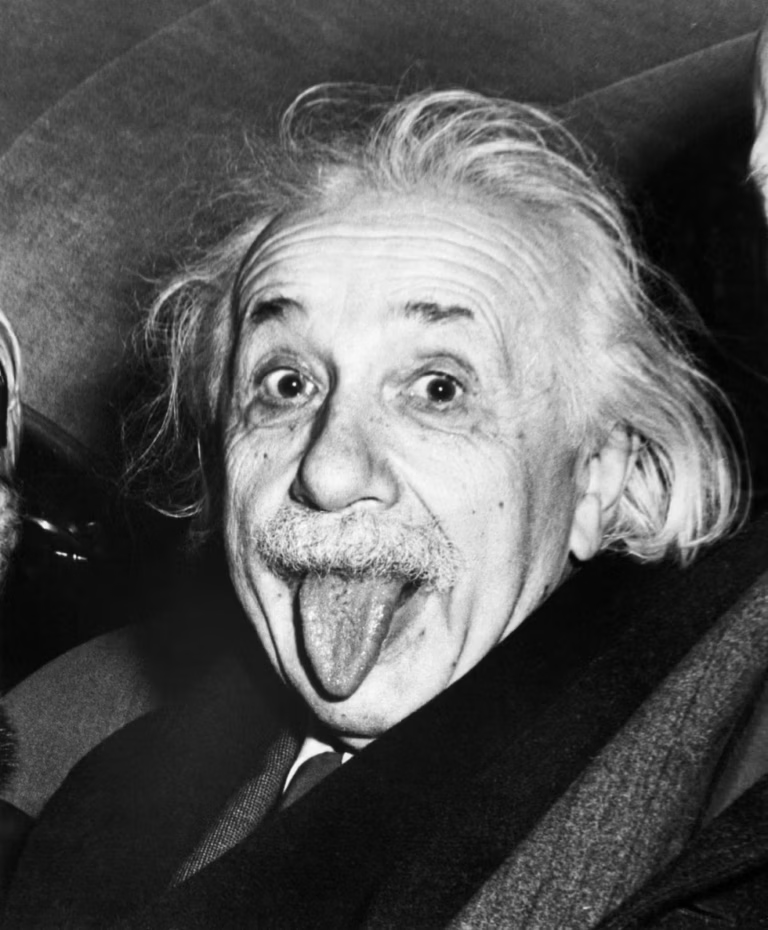
Who would not want to step inside the mind of one of the greatest physicists in history and understand the nature of his genius?
Of course, we cannot truly do that. But we can try to read his astrological portrait and see what it reveals. In this article, you will find an in-depth analysis of Albert Einstein’s birth chart, exploring the astrology of the brilliant mind behind the theory of relativity.
Albert Einstein Birth Chart: Birth Data and Astrological Context
Albert Einstein was born on March 14, 1879, in Ulm, Germany. His birth data is rated AA according to the Rodden Rating system used by Astro-Databank, which is the highest level of reliability in this classification. This means that the birth information comes from a highly trusted source, such as an official record or documented birth data.
This is especially important in astrology because the birth time is the most sensitive element of a natal chart. It determines the Ascendant, the houses, and the exact structure through which the planets express themselves. With an AA Rodden Rating, we can analyze Albert Einstein’s birth chart with a strong level of confidence, including his Ascendant, his moon’s position and house placements.

Albert Einstein’s Big Three: Pisces Sun, Cancer Rising, and Sagittarius Moon
Albert Einstein’s personality is already so complex, fascinating, and structured that, at least for this analysis, it may be better to begin in the most classic way: with his Big Three.
For those who are new to astrology, the Big Three are considered three of the most important and defining placements in a birth chart: the Sun, the Ascendant, and the Moon. These three alone can already summarize much of a person’s essence, even without the rest of the chart, although the other placements, of course, add a much more refined and nuanced reading.
Albert Einstein had the Sun in Pisces, in the Tenth House. And here, astrology shows us once again that it is never obvious. A scientific mind, devoted to study, formulas, and calculation, was born under a water sign that, at its core, speaks of vision. Because Pisces is, in many ways, the opposite of analysis. Not by chance, it is the opposite sign of Virgo, the sign of precision, method, and pure calculation. Pisces is also the opposite of order. Pisces is chaos, imagination, dissolution, intuition.
At first, this may seem strange. And yet, I find it to be an incredibly accurate portrait of Einstein: vision, abstraction, creativity, and deep emotional intelligence. These are all ingredients that can lead to creation and discovery, because they allow the mind to move beyond what is visible.
And after all, is this not exactly what Einstein did? He never settled for what was already visible, obvious, or transparent.
Pisces Sun in the Tenth House: Imagination Made Visible
Albert Einstein was a true creative in the purest sense of the word, because he did not approach physics through mathematical logic alone, but through imagination and thought experiments. He himself famously said that “imagination is more important than knowledge.”
His Pisces Sun is also particularly well-supported astrologically, as it forms two sextiles, both harmonious aspects: one with Mars in Capricorn and the other with Pluto in Taurus.
It is interesting that Pluto, the planet of inner upheaval and the ability to transform and revolutionize oneself, is placed in such a traditional and rooted sign. The same can be said of Mars, also placed in an earth sign. These two aspects may have helped this visionary Sun translate its inner visions into discoveries.
From the infinite, indistinct ether of imagination to the most solid earth.
Cancer Rising: Looking at the Universe Through Feeling
Some of you may already know that I wrote an entire book dedicated to the Ascendant and to all the 144 possible combinations it creates with the Sun. It is called Born Under A Rising Sign and it is availble worldwide. It is my first astrology book, and I chose to write it about the Ascendant because I believe it is one of the most meaningful elements of our astrological portrait.

And yes, sometimes the Ascendant can help us understand ourselves even more deeply than the Sun. This is because the Ascendant does not only describe how we are seen by others, but also the eyes through which we ourselves look at the world.And we know that Einstein looked at the world through the eyes of Cancer Rising.
This speaks of a pure water combination, because water is the element that governs both his Pisces Sun and his Cancer Ascendant. The vision, the ability to receive, express, and work through emotion, is enormous. But so is the empathy.
Einstein was a scientist very far from the cold stereotype of the detached analyst. His love letters are famous, as are his commitment to human rights and his respect for the animal world. Cancer Rising looks at life with the desire to give, to offer, to give before receiving.
This is not merely kindness. It is an authentic need to protect, to nurture, and to care for human resources, human dignity, and human potential. It is, in other words, a maternal approach to life: one that does not see the world as a collection of separate objects, but as something living, fragile, interconnected, and worthy of care.
Sagittarius Moon in the Sixth House: The Fire Inside the Mechanism
The third element of Einstein’s Big Three breaks the water pattern and enters the chart like fire. His Moon was in Sagittarius, in the Sixth House.
Here, the Sixth House is especially meaningful, because it is the astrological house that also speaks of science, thought, method, and calculation brought into everyday life. But we must be careful: it does not speak of the grand events of existence, not of life in its most spectacular form. The Sixth House speaks of the small things, of the silent and microscopic mechanisms that make the whole machine work.
As the person writing this article, I feel I know this placement quite well, because it is my own Moon sign too, although mine is in the Third House, and this changes the expression quite a lot.
The Sagittarius Moon is truly a huge, nervous movement within the birth chart. It brings fire, restlessness, hunger for meaning, and the need to keep expanding beyond whatever feels too narrow. And sometimes, it is not an easy energy to manage.
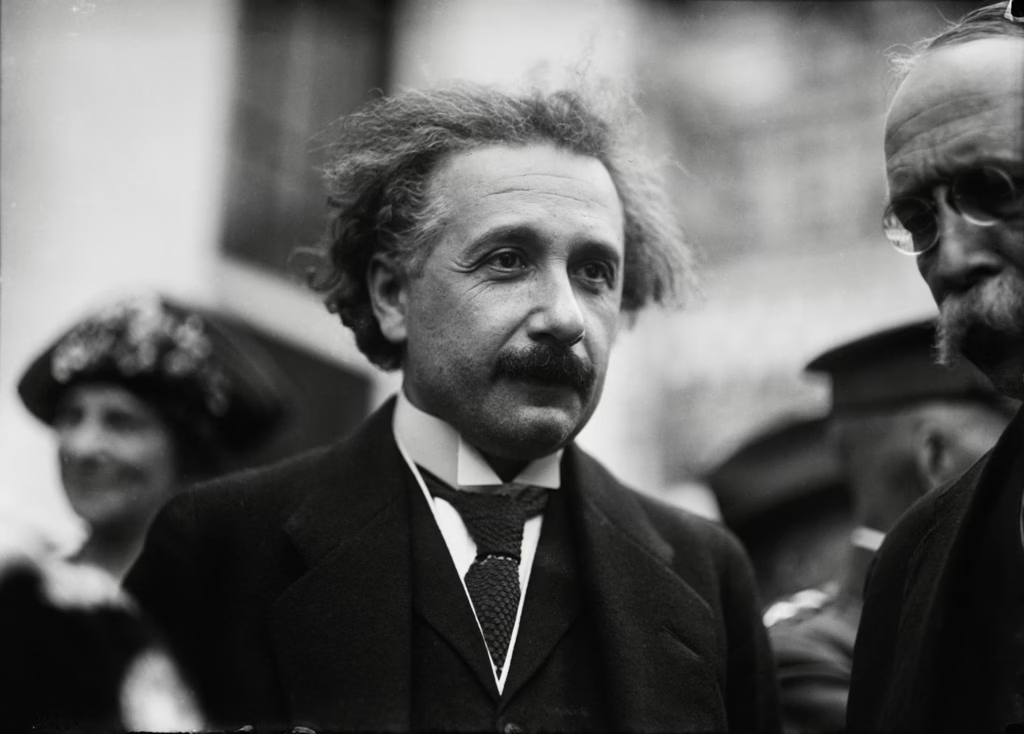
The Bucket Shape: Uranus as the Key to Einstein’s Genius
When we read a birth chart, we should try to do so by forgetting the person for a moment: what we already know about them, the images we project onto them, and even what the person says about themselves.
This is easier when we are reading the chart of someone we do not know, or someone whose most extraordinary qualities have not yet fully emerged, which, of course, does not mean they are not there. But it becomes much harder when we are looking at iconic figures, or at people whose lives have influenced the destiny of the planet and the collective.
And yet we do it anyway, because perhaps there is something beautiful in searching for what we already know and trying to give it meaning through the symbolic language of astrology.
So, in this fascinating birth chart, we can try to answer the question: where do we see Einstein’s revolutionary genius?
There may be several ways to approach this. A birth chart is made of many symbols, and when different symbols are expressed strongly, they can often lead us toward the same meaning. My interpretation of Einstein’s genius focuses especially on Uranus, which forms a bucket shape with the rest of the planets in his chart.
A bucket shape occurs when all, or almost all, of the planets are concentrated on one side of the chart, while one planet stands alone on the opposite side, as if holding the rest of the chart together. The fact that Einstein’s isolated planet is Uranus is almost astonishing from a symbolic point of view.

Uranus is the planet of genius, sudden insight, rebellion against established rules, nonconformity, physics, and the future. In a bucket-shaped chart, the isolated planet becomes the point through which the energy of the entire chart is released. It is as if all the accumulated force of the other planets, his thoughts, emotions, visions, impulses, and inner tensions, were channeled through the frequencies of Uranus.
This gives us an almost visual explanation of why his entire existence seemed to be guided by flashes of pure genius and by a visceral need to dismantle the scientific status quo.
Uranus in the Third House: The Genius First Seen by His Sister
Einstein’s Uranus is placed in the Third House, which is not only the space of the mind, language, and thought, but also the area of the chart that speaks of siblings.
This is also deeply meaningful, because part of Einstein’s life was connected to his beloved sister, Maja, who is said to have been one of the few people able to understand his genius when he was still a child. At that time, his brilliance was not yet expressed through the discoveries we can now recognize and celebrate, but through a more restless, painful form of rebellion.
It is almost as if Uranus were placed there to be discovered first by those closest to him, by the sibling who could see the spark before the world knew how to name it.
Uranus Opposite Jupiter: The Astrology of Exile and Discovery
So far, all the planets we have analyzed form only flowing major aspects, with no particularly challenging or growth-oriented aspects. However, although weaker because of its wide orb, there is an interesting opposition between that defining Uranus and Jupiter, between the Third House and the Ninth House.
This is an axis that speaks of the familiar and the distant, of roots and travel, of settlement and nomadism, of the place we come from and the world that calls us elsewhere. In 1933, while Einstein was traveling in the United States, the Nazis raided his home in Germany and placed a bounty on his head. Einstein could never return home again.
Here, the harsher side of Uranus in the Third House opposing Jupiter becomes visible. Travel, discovery, and distance are not always born only from desire or choice. Sometimes they are born from rupture, necessity, exile, or catastrophe.
Uranus as the Release Point: From Chaos to Theory
Einstein’s Uranus is one of the most delicate and powerful points in his birth chart, because it acts both as a release point and as a central focus of energy. From this Uranus come the electric shocks that seem to animate the rest of the astrological symbols, while at the same time Uranus itself receives the pressure of the more populated area of the chart.
This Uranus represents the electric energy he could not fully channel as a child: the energy that led him to feel rejected, isolated, and seen as a disordered rebel. But it is also the same Uranus that later transformed that chaotic force into theories.
Because Uranus is rebellion, yes, but it is also reconstruction. It breaks the old structure not simply to destroy it, but to make space for a new one.
And it is deeply symbolic that Uranus is also connected to speed: the very speed that Einstein studied, understood, and placed in relation to space and time.
Saturn in Aries: The Mind That Made Time Fluid
Time is another foundational theme in Einstein’s birth chart. Time, to which Einstein dedicated such an important part of his thought, is represented by Saturn in Aries in the Tenth House.
The Tenth House is the house of career, public exposure, the outer world, and the place where we decide which role we are willing to embody in society. It is precisely here that Einstein has Saturn conjunct Mercury, the planet of thought, reasoning, and intellectual process.
If you want to know more about Mercury in Aries, you can read our in-depth guide. But the most significant thing about this placement is undoubtedly the fact that this is not a “calm” Saturn. It is Saturn placed in a sign that is, in many ways, very far from its own nature.
Saturn is structure, time, discipline, tradition, and containment. Here, however, it is colored by the fire of Aries, a sign that does not experience time only as a limit or a threshold, but as a means to reach a purpose. This revolutionary concept is connected to his Mercury, the mind, conjunct Saturn, the structure.
Einstein literally took the rigid structure of the universe and made it fluid.
Explore More Celebrity Birth Chart Analyses
Dua Lipa Birth Chart: The Astrology of Voice, Fame, and Fire
Jonathan Bailey’s Birth Chart: The Astrology Behind His Magnetism
Bad Bunny’s Birth Chart Reading – Super Bowl Edition
Billie Eilish Birth Chart Explained in Depth
Rihanna’s Birth Chart: Astrology Behind the Icon