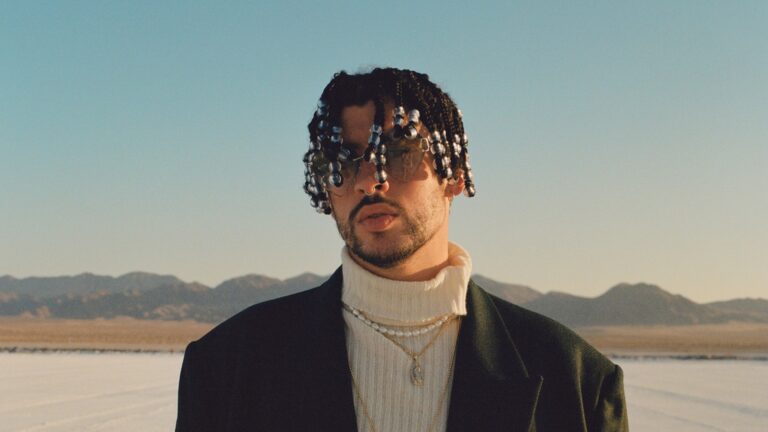
When the announcement arrived, it felt less like a surprise and more like a confirmation of something already written in the cultural air: Bad Bunny will headline the Super Bowl 2026 Halftime Show. Not as a guest, not as a supporting act, but as the main performer of the most watched ritual of contemporary pop culture.
The Super Bowl, historically a temple of American spectacle, meeting an artist who has built his empire without translating himself or asking permission, is not just a booking choice. It is a cultural statement. And astrologically, it makes perfect sense.
His participation has divided public opinion, and politics more than anything else. As always, there are those who cling to his origins, labeling him a “foreigner” and framing his presence as a betrayal of the flag. It is worth stating, first and foremost, that Bad Bunny is an American citizen. But beyond legal definitions, his appearance at the Super Bowl invites a deeper reflection.
If his presence on that stage reminds us of the value of multiculturalism, of a country shaped by multiple languages, histories, and identities, then it should be welcomed, not feared. Culture does not weaken when it expands; it evolves. And the Super Bowl, as a collective ritual, has always reflected not a static idea of America, but the one that is emerging.
Was Bad Bunny always destined to be this divisive? To explore that question, we need to turn to his birth chart, with one important clarification. We do not have his exact time of birth, which means the astrological houses remain unknown. For this reason, any reading must stay anchored to what we can reliably observe.
Bad Bunny’s Birth Data and Astrological Method

Bad Bunny was born on Thursday, March 10, 1994, in San Juan, Puerto Rico (United States), making him a Pisces Sun. As his exact time of birth is not publicly available, his Ascendant — and therefore the astrological houses — cannot be determined with certainty.For the purpose of this analysis, we will use 12:00 PM as a reference time, not to define his Ascendant, but simply as a technical anchor to observe planetary sign placements and aspects. This approach allows us to work with what astrology can reliably offer in the absence of a verified birth time, without forcing interpretations where accuracy would be compromised.
Whether you know the exact birth time or not, you can calculate your own (or anyone’s) birth chart here. You’ll get a beautifully designed chart, visually similar to the Bad Bunny one shown above.
His Pisces Sun as Collective Channel
Pisces, as an archetype, doesn’t build influence by insisting. It builds it by absorbing. A Pisces Sun often moves through the world like a permeable field: it picks up moods, symbols, collective desires, and then gives them back in a form people can finally feel. That’s what I mean by cognitive resonance: the ability to embody something that already exists in the collective psyche, but hasn’t yet found a voice, a style, or a face.
With Bad Bunny, the “division” isn’t only about opinions on his music or his presence on a stage like the Super Bowl. It’s about projection. Pisces energy tends to become a screen. People don’t just see the person, they see what they fear, what they long for, what they can’t integrate. In that sense, he doesn’t simply represent a cultural shift; he becomes the vessel through which that shift is experienced. And vessels are rarely neutral. They’re loved and attacked with the same intensity, because they carry more than themselves.
This is also why Pisces figures can feel paradoxical: soft but disruptive, elusive yet massively influential. They don’t always “fight” the old order directly. They dissolve it. They blur boundaries until the boundary stops holding. And for a society built on rigid categories, language, identity, nationality, gender — that can feel like liberation… or like threat.
Bad Bunny, with a Pisces Sun, reads like an emotional soul tuned to the whole: the poet archetype, the one who doesn’t simply “say” something, but lets it leak through atmosphere, image, rhythm, longing. This is not just passion for music in the straightforward sense. It’s closer to necessity. For many Pisces Suns, art isn’t a hobby, it’s a language the psyche chooses when ordinary language feels too sharp, too literal, too inadequate.
Sun Sextile Uranus and Neptune
Bad Bunny’s Pisces Sun forms a close sextile to Uranus and Neptune in Capricorn (we can’t place these in houses without a birth time, but the aspect itself remains valid).
The key point is Neptune: whether we work with the modern rulership (Neptune) or keep the traditional layer in mind (Jupiter), a strong Sun–Neptune connection intensifies the “Piscean” frequency. It doesn’t simply make someone “sensitive.” It makes them porous: receptive to atmospheres, collective moods, longing, nuance, the invisible emotional weather other people ignore.
The sextile matters because it’s not a dramatic, self-destructive aspect. It’s usable. It suggests a talent for turning an inner ocean into form. And because Neptune and Uranus sit in Capricorn, the sign of structure, ambition, and public architecture, that sensitivity doesn’t remain private. It gets translated into something concrete: image, sound, discipline, strategy, brand, stage.
A Pisces Sun so intensely connected to Capricorn (through Neptune/Uranus) often describes a person who learns, sometimes early, sometimes through necessity, that sensitivity must become structure if it’s going to survive. Capricorn doesn’t romanticize inspiration; it asks: what are you building, exactly?
That’s why this combination is perfect for the “self-made” narrative, not in the mythic sense of “alone against the world,” but in the practical sense: turning inner material into outer form. Pisces provides the ocean of feeling, intuition, imagery. Capricorn provides the container: discipline, timing, strategy, craft, consistency. When those two actually cooperate, you get someone who can take a private vision and make it public, without losing the emotional charge that made it powerful in the first place. This blend often creates an artist who is both soft and serious. Tender, yes, but not naïve. Romantic, yes, but with a backbone. The kind of person who can let the world project onto them… and still keep steering the ship.

Saturn and Mars in Pisces
And what about Saturn, Capricorn’s ruler? In Bad Bunny’s chart, Saturn is in Pisces. It isn’t close enough to the Sun to be considered conjunct, but it sits near his Mars (also in Pisces — yes, that’s a lot of water). And this detail sharpens the portrait even more.
Mars in Pisces is not the classic warrior. It fights sideways, through symbolism, through emotion, through art, through presence. It acts from empathy and instinct, and it often refuses the crude, loud language of conflict. When Saturn comes close to Mars, something important happens: the softness gains backbone. The sensitivity gains discipline. The “I feel everything” becomes “I can hold it.”
This is how you get what I’d call a sweet warrior, or a warrior made of sweetness. Someone who can be tender without becoming fragile, and assertive without becoming brutal. There’s a quiet authority to Saturn–Mars: the capacity to endure, to focus, to build a path slowly, even when the emotional tides are strong. And honestly, his stage name already tells the story…
“Bad Bunny” is a contradiction on purpose: the soft creature with the sharp edge, innocence with teeth. That’s Pisces (myth, tenderness, permeability) meeting Saturn (control, boundaries, gravity). He doesn’t choose one , he embodies both. And that’s exactly why people can’t agree on him: he short-circuits categories.
The Water Element at Work
And his water signatures don’t stop with Sun, Saturn and Mars in Pisces.
Jupiter and Pluto are in Scorpio, and while Pluto is generational (a slow-moving planet, and without a birth time we can’t locate it by house to refine its personal expression), this concentration of Water already speaks loudly through the chart’s overall atmosphere.
What makes it especially relevant is Jupiter’s trine to his Pisces Sun (a wide trine, but still effective). This is a classic signature in many artists: not because it “guarantees fame,” but because it amplifies the native’s capacity to transmit meaning. Jupiter is expansion, yes, but also reach. It’s the ability to take something intimate and make it travel.
In symbolic terms, Jupiter is the voice that crosses borders. Not only geographic ones, but emotional ones: it carries feeling beyond the private room and into the collective space. With Jupiter in Scorpio, that voice isn’t superficial. It doesn’t float on the surface. It goes for the marrow: desire, taboo, devotion, loss, obsession, metamorphosis. Scorpio gives Jupiter intensity and magnetism, the kind that makes people listen with their bodies, not just their minds.
Put together, this is why his artistry can feel both global and deeply personal at the same time. Pisces gives him the ocean of sensitivity; Scorpio gives him depth and psychic gravity; Jupiter gives him breadth, the megaphone, the bridge, the “how did this reach me all the way here?” factor. And yes: that’s extremely singer-coded.

The Square That Shapes the Artist
Mars in Pisces and Pluto in Scorpio form one of the most telling tensions in his chart, especially because it’s an out-of-sign square: by sign, Pisces and Scorpio “understand” each other (they’re both Water, both fluent in depth), but by degree they can still clash, creating a 90° angle that behaves like a real square.
This is the conflict of two waters that don’t soothe each other: they pull. Mars in Pisces acts through emotion, intuition, softness, and suggestion. It doesn’t want to dominate; it wants to merge, to move around obstacles, to win without brutality.
So when these two meet in a square, you get a very specific kind of inner electricity: the gentle impulse (Mars in Pisces) colliding with a force that doesn’t allow half-feelings (Pluto in Scorpio). It can show up as an artist who carries tenderness and danger in the same body, someone who can sing with vulnerability while his work still feels charged, erotic, taboo, confrontational, capable of stirring controversy without ever needing to shout. And culturally, this is one of the clearest signatures of a public figure who can divide people: not because he tries to provoke, but because his energy doesn’t stay on the surface.
On a personal, individual level, the person rather than the artist, this aspect can describe a real inner friction. A kind of private tide-pull between what he might imagine himself to be, and what he keeps becoming. In symbolic terms, the Sun speaks of the ideal “I”: the identity one aspires to inhabit with clarity, the center one wants to stand in. Mars, instead, is the self in motion: desire, instinct, action, the part of us that moves first and explains later. And when Mars in Pisces is tensioned by Pluto in Scorpio, that movement is never neutral, it carries transformation, intensity, and the need to shed skins.
So the conflict you’re pointing to makes sense: the “ideal self” can feel constantly challenged by an inner force that refuses stasis. He may experience phases of deep reinvention, moments where the old identity no longer fits, even if it was once a dream. And because Pisces is involved, that struggle isn’t loud or purely mental, it can be emotional, somatic, almost atmospheric. He feels the mismatch before he can name it.
Certainly, Bad Bunny seems to know that inner storms are not meant to be avoided. Escaping them is never the solution, it only delays the encounter. The real answer is to face them, to step directly into the eye of the cyclone. And there, paradoxically, one discovers stillness.
Bad Bunny’s appearance at the Super Bowl will undoubtedly be a divisive moment, and for that very reason, a powerful one. For him, it will be a precious opportunity to let his voice, his idealism, and his identity reach the collective. Perhaps he won’t deliver a clear, explicit message, but his identity will speak for him.
Here we’ve explored the main elements of Bad Bunny’s birth chart, and they already tell a powerful story. Yet one crucial piece remains missing: the Ascendant.
Knowing it would allow us to understand how this energy moves into the world, how his presence is perceived, and which lens shapes the expression of everything we’ve read so far.
The Ascendant is not a detail. It’s the doorway through which a chart comes alive.
If you want to understand why the Rising sign matters so deeply, and how it changes the entire reading, the book Born Under a Rising Sign by Deborah Rossetto is a profound place to begin.
It’s not about prediction. It’s about orientation.