
This blog post contains affiliate links. Visit the full disclosure to know more.
Before we unveil the card(s) associated with Scorpio (spoiler alert: it’s not just one card!) let’s clarify something. There’s no universal correlation between zodiac signs and tarot cards. It might seem odd to mention this at the beginning of an article promising to reveal the connection between Scorpio and tarot, right? It’s crucial to note that while similarities exist, it’s not set in stone. Interpretations can vary depending on the reader and even the specific tarot deck used.
With that said in the introduction, let’s now explore which tarot card(s) are symbolically connected to Scorpio. Ready? 3, 2, 1, let’s dive in!
Quick answer: which tarot card represents Scorpio?
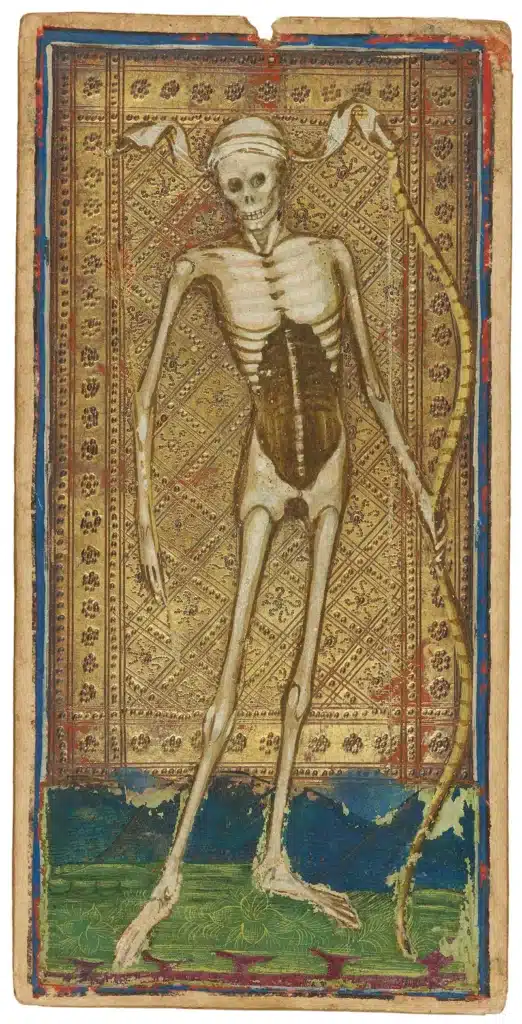
The tarot card most traditionally associated with Scorpio is the Death card, a Major Arcana archetype of transformation, endings and rebirth. Beyond this formal correspondence, The Tower and The Devil can also resonate with some Scorpionic themes, especially intensity, crisis, desire and transformation, although neither card is formally assigned to Scorpio.
Scorpio is also associated with the suit of Cups through its water element. In the Minor Arcana, its three decans correspond to the Five, Six and Seven of Cups. In short, Scorpio has one principal Major Arcana correspondence, Death, two additional symbolic parallels, The Tower and The Devil, and a clear Minor Arcana connection through the Cups.
Scorpio and the Death tarot card
Scorpio is often linked to the Major Arcana card “Death”. For a deeper understanding, we recommend checking out the article entirely devoted to the description and meaning of the Death tarot card.
In the Death card, depicted in the Rider-Waite version, we see a skeleton riding a white horse, symbolizing the impartial force of change. The Death card represents transformation, renewal and new beginnings. It’s no coincidence that Scorpio is deeply connected to these themes. This zodiac sign is associated with the concept of rebirth, constantly evolving through experiences. Scorpio delves into the unknown, unafraid of exploring the dark corners of the soul.
In the Rider-Waite version of the Death tarot card, the Sun shining between the two towers on the horizon suggests continuity beyond endings and the beginning of another phase. Scorpio is deeply intertwined with this symbolism: it embodies power and transformation, acting as a catalyst for change. This symbolism is further evident in the four human figures depicted on the Death tarot card: a fallen king, a bishop, a child, and a maiden, representing different ages and positions in life in the face of change.
There are many more symbolic associations to uncover. Let’s delve into them by understanding the connection between the keywords of the Death card and the characteristics of Scorpio.

The Death tarot card’s keywords associated with Scorpio
As many of us know, in Tarot, “keywords” are concise phrases or single words associated with each tarot card. They help quickly identify the card’s meaning and guide interpretation.
The tradition of associating keywords with tarot cards dates back to the 1700s with the Etteilla Tarot. Etteilla, a renowned French esotericist, played a significant role in popularizing tarot cards within esotericism, as discussed in our dedicated article on the History of Tarot.
Keeping this in mind, let’s delve into how the keywords of The Death tarot card (both upright and reversed) are intricately connected with the characteristics of the Scorpio sign. While we’ve listed The Death’s keywords here, let’s reiterate some of them here and examine their connection to Scorpio’s essence. We’ll start with Transformation…
Transformation
“Transformation” is not only the first upright keyword of the Death tarot card but also deeply associated with Scorpio. Governed by Pluto, the planet of profound transformation, power, and rebirth, Scorpio surely embodies the essence of transformation.
Pluto, the distant and enigmatic planet, rules over the intense sign of Scorpio. As the planet of transformation, destruction, and rebirth, Pluto influences endings and new beginnings. Its energy is deep and transformative, often associated with the subconscious and the unseen. Pluto embodies the process of death and regeneration, symbolizing the cycle of life, decay, and renewal.
Regarding the Death card, as we mentioned in the upright meaning of the card: “In its upright position, the Death card in the Rider-Waite Tarot deck unveils a narrative of profound transformation and renewal. Serving as a herald of radical change, this card symbolizes the inevitability of metamorphosis.”
It’s no coincidence that the highlighted sentence in the paragraph dedicated to the upright meaning of the Death tarot card is: “Embrace profound transformation and accept that endings can be a gateway to new beginnings.”

Rebirth
“Rebirth” is another upright keyword of the Death tarot card, deeply associated with the Scorpio sign, which embodies the concept of rebirth and constant evolution through experiences.
In the bestseller “The Way of Tarot”, Jodorowsky offers insightful perspectives on the Death card, emphasizing that it doesn’t represent final death but rather rebirth. He notes that this card isn’t positioned at the end of the Major Arcana but just past the halfway point. If it were at the end, it might signify actual death, but its placement suggests otherwise. Positioned just past the midpoint of the Major Arcana, it encourages us to view it as a cleansing process, a rebirth, and renewal, rather than the end of everything.
Fear of change
“Change” stands as a significant upright keyword of the Death card, while “Fear of Change” represents its reversed counterpart, and it’s easy to understand why.
In the Rider-Waite Tarot version of the card, four human figures confront the skeletal rider: a fallen king, a bishop, a child, and a maiden. Together, they suggest that change and mortality reach everyone, regardless of age, status, or experience. Change is an inevitable force that transcends age, status, and experience. However, when the card is reversed, there is a “Fear of Change”. As we noted in the dedicated article on the Death card’s reversed meaning: “Don’t resist change.”
How does Scorpio relate to the Fear of Change? It’s simple. While Scorpio is a water sign, it is also a fixed sign. Fixed signs are resistant to change and value stability, making Scorpio prone to a fear of change. Scorpio is afraid of changes, particularly those beyond its control, and tends to approach situations it cannot control or fully understand with suspicion and wariness.
Two other Major Arcana cards that can resonate with Scorpio
Beyond Scorpio’s traditional correspondence with Death, two other Major Arcana cards can resonate with some of the sign’s themes: The Devil and The Tower. These are symbolic parallels rather than Scorpio’s formal astrological correspondences. The Devil is also traditionally associated with Capricorn, while The Tower is also associated with Mars.
Still, both cards touch on themes that can feel distinctly Scorpionic. The Tower speaks of upheaval, collapse and the destruction of structures that can no longer stand, echoing Scorpio’s association with crisis, transformation and regeneration. The Devil, meanwhile, explores desire, temptation, attachment and the more instinctive or shadowy side of human nature, themes that can also resonate with Scorpio’s intensity and interest in what lies beneath the surface.
The Devil card is particularly interesting in relation to Scorpio because both are often associated with passion, desire and sexuality. Some of the card’s upright themes include temptation, pleasure and hedonism, while Scorpio is traditionally characterized in astrology as an intense and deeply passionate sign, including in the way it approaches intimacy.
Why Scorpio is also associated with the Cups
The cards we’ve met so far – Death, The Tower and The Devil – all belong to the Major Arcana, where Scorpio’s archetypal “big picture” plays out. But Scorpio’s influence also runs through the Minor Arcana, the 56 cards of everyday experience, and it does so through one suit in particular.
In traditional astrology, Scorpio is classified as a water sign, and in Tarot the element of water is expressed by the suit of Cups. Cups symbolize emotions, intuition, sensitivity, and the inner world, and are often intertwined with themes of emotional life, relationships, love, spirituality, and the profound depths of human experience. You can see the connection from the very first card of the suit: the Ace of Cups tarot card, an overflowing cup that symbolizes the flow of emotions. In short, Scorpio’s alignment with the Cups mirrors its nature as a Water sign.
But this affinity runs deeper than the suit as a whole. Zoom in, and Scorpio maps onto three specific Cups cards through its decans: the part most Scorpio tarot guides leave out.
Scorpio’s Minor Arcana: the Cups of the three decans
In the Golden Dawn system, each zodiac sign is divided into three decans of ten degrees each, and each of the 36 decans is matched to one of the numbered Minor Arcana cards from Two through Ten. Since Scorpio is a fixed water sign, its three decans correspond to the Five, Six and Seven of Cups. Each decan also carries its own planetary attribution: Mars, the Sun and Venus respectively. The first of these brings back Mars, Scorpio’s traditional ruler, alongside the sign’s modern association with Pluto.
Here’s how Scorpio’s decans line up with the Cups:
- First decan: Five of Cups (≈ 23 October – 1 November, sub-ruled by Mars). Keywords of loss, grief and disappointment. This is the Scorpio that feels endings intensely and must learn to turn toward what still stands rather than what has spilled, the shadow side of the sign’s depth.
- Second decan: Six of Cups (≈ 2 – 12 November, sub-ruled by the Sun). Keywords of memory, nostalgia and emotional warmth. Here Scorpio’s intensity softens into loyalty and the long emotional bonds this sign is famous for keeping.
- Third decan: Seven of Cups (≈ 13 – 22 November, sub-ruled by Venus). Keywords of illusion, fantasy and choice. This is Scorpio the seeker of hidden truths, tempted by mystery and asked to tell real desire from projection.
The court card most directly associated with Scorpio is the King of Cups, who in the Golden Dawn-derived Rider-Waite system rules from 20° Libra to 20° Scorpio. His emotional depth, controlled exterior and powerful inner currents resonate strongly with Scorpio’s fixed-water nature.
Taken together, the Cups of the decans give Scorpio something the single Death card can’t: a day-to-day emotional map: loss, memory and illusion, that sits underneath the sign’s dramatic reputation.
FAQs about Scorpio’s tarot card
Scorpio’s main tarot card is Death, a Major Arcana card of transformation, endings and rebirth — themes that mirror Scorpio’s own cycle of shedding and renewal.
Yes. Scorpio’s principal Major Arcana correspondence is Death. In the Minor Arcana, its three decans correspond to the Five, Six and Seven of Cups. The Tower and The Devil can also resonate symbolically with Scorpio, but they are not its formal astrological correspondences.
The Five, Six and Seven of Cups, one per decan, with the King of Cups often added as Scorpio’s court-card counterpart.
The suit of Cups, because Cups embody the water element that governs Scorpio.